Cancer care is shifting from one-size-fits-all
The first real jolt often isn’t the diagnosis itself—it’s how quickly the plan starts to feel like it’s written in pencil. One visit ends with “we’ll start chemo,” and the next includes a new scan, a request for more tissue, or a call about sending the biopsy for additional testing. To many people, that whiplash can read as uncertainty or backtracking, especially when you’re trying to keep work schedules and family logistics intact.
In practice, it’s often a stepwise approach: doctors begin with what’s most likely to help, then adjust as more specific information shows up. That may mean the team pauses to clarify stage, waits for lab markers that suggest a better-fit medicine, or uses early response checks to decide whether to continue, switch, or add something. The frustrating part is that “next-line” or “we’re changing course” doesn’t always mean things are worse—it can simply mean the cancer is being described more precisely than it was on day one.
Molecular testing reframes what the cancer ‘is’
The confusing part can be how a small detail on a pathology report suddenly carries more weight than the tumor’s location. One day it’s described as “lung cancer” or “breast cancer,” and the next you’re hearing about mutations, receptors, PD-L1, MSI, HER2, or “gene fusions.” It may feel like the diagnosis is changing, when what’s really changing is the level of resolution—like switching from a street address to an exact apartment number.
Molecular testing reframes what the cancer “is” because it groups tumors by behavior and vulnerabilities, not just by where they started. That’s why the team may ask for more biopsy tissue, order a liquid biopsy, or send samples for next-generation sequencing even after treatment has been discussed. The limitation is time and clarity: results can take weeks, not every sample yields enough DNA, and some findings land in a gray zone (“variant of uncertain significance”). Still, those details often explain why a plan is delayed, narrowed, or suddenly aimed at a very specific target.
Targeted therapies change both benefits and trade-offs
It’s often a small phrase—“you have a target,” or “this medicine is matched to that mutation”—that lands with a mix of relief and suspicion. Targeted therapy can sound like a cleaner, gentler version of treatment, especially compared with the broad reputation of chemotherapy. But in real life, it’s usually more specific rather than universally easier, and the trade-offs can show up in different places than people expect.
When a tumor has a clear driver (a receptor, fusion, or mutation the cancer depends on), a targeted medicine may deliver a more direct hit and sometimes faster symptom improvement. The logic is straightforward: if the target is present, the odds of benefit may rise; if it isn’t, the same medicine can become busywork with side effects. The targets aren’t always stable, and responses can fade as the cancer adapts. That’s why plans often include repeat scans, “resistance” language, or even another biopsy—less as a reset, and more as a way to see what changed.
Immunotherapy expands hope, and new confusion

Sometimes it’s the new side of the waiting room that gives it away: you came in expecting an infusion “like chemo,” and instead the nurse talks about teaching your immune system to recognize cancer. Immunotherapy can feel like a breakthrough—fewer baldness jokes, more stories about long responses—so it’s easy to assume it’s either the obvious next step or the “strongest” option. That’s where confusion creeps in, especially when two people with the same cancer type are offered completely different plans.
In many clinics, immunotherapy is less a default and more a match: markers like PD-L1, MSI-high/dMMR, or tumor mutational burden may shift the odds that it will help, and the team may treat those results almost like a compass. The side effects don’t always look like classic chemo toxicity; they can show up as inflammation in unpredictable organs, sometimes after a few doses, sometimes later. That uncertainty is why the plan may include extra labs, symptom checklists, and quick “hold treatment” decisions that can feel abrupt but are often protective.
Radiation and surgery are becoming more selective
It can be disorienting when the “big” options—surgery or radiation—get discussed in a surprisingly narrow way. People often picture them as the straightforward fix: remove what you can see, or zap what’s left. But in many plans now, imaging details and response checks quietly decide whether these treatments are worth the disruption. A surgeon may sound hesitant not because surgery is off the table, but because the margin for benefit depends on what’s happening beyond the main tumor, how close it is to critical structures, and whether earlier therapy has already shrunk the highest-risk areas.
Radiation can look similar from the outside (same machine, same schedule), yet the intent may be very different—sometimes aiming to control one stubborn spot, sometimes to reduce recurrence risk, sometimes to ease a specific symptom. The trade-off is effort and uncertainty: more mapping scans, more visits, and occasional plan changes midstream if the target shifts or side effects start stacking up. Over time, “selective” often means the team is protecting function as much as chasing maximum intensity.
Combination strategies create synergy and complexity
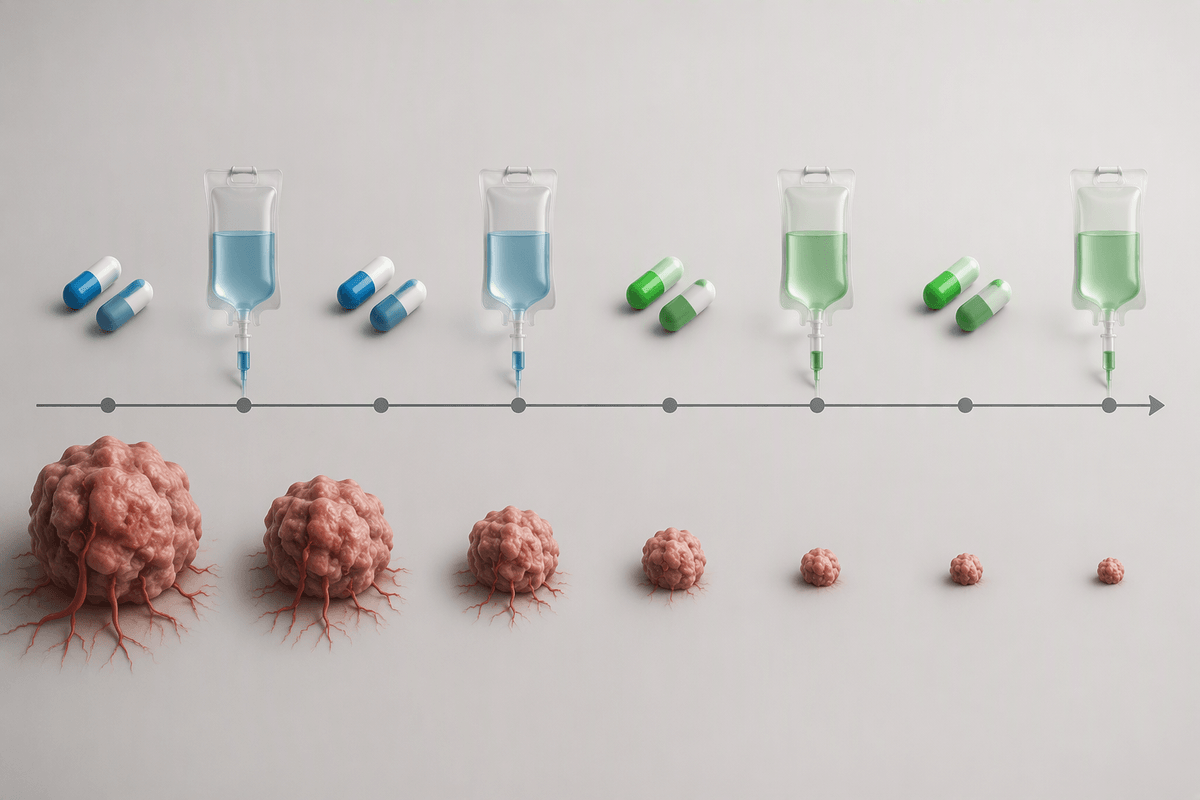
The moment a second medicine gets added, many people feel a quiet alarm: if the first plan was “right,” why does it suddenly need help? On paper, combination treatment can look like escalation. In the day-to-day reality of appointments, it often shows up as more calendars to manage—labs on one day, infusion on another, a new pill schedule at home—plus a new set of side effects that don’t line up neatly with any single medication.
Clinically, combinations are often built to create synergy: one therapy may shrink visible disease while another reduces the chance of regrowth, or one may make the tumor more vulnerable to the next step. The complexity is that timing matters. Some medicines have to be sequenced to avoid overlapping toxicity, while others are paired because the first can change the tumor’s behavior (or the immune environment) in a useful way. That’s why you may hear “induction,” “maintenance,” or “consolidation,” and why response scans can trigger a swap that sounds dramatic but is sometimes just the planned handoff.
Living longer changes the meaning of outcomes
It can be a strange moment when the conversation shifts from “getting through treatment” to “staying on it.” A scan shows improvement, yet the plan doesn’t simply end—it changes shape. People sometimes hear “stable disease” and feel disappointed, not realizing that in some cancers that phrase can mean the illness is being managed more like a long-term condition than a short, decisive battle.
Living longer can make outcomes feel less like a single finish line and more like a series of trade-offs: fewer symptoms versus more appointments, lower risk of regrowth versus ongoing fatigue, a stronger regimen now versus preserving function for later. This is also where “maintenance,” dose reductions, treatment breaks, or switching to a different “line” may show up even without dramatic bad news. The uncertainty is that longer timelines leave more room for cumulative side effects, late immune reactions, or slow changes on imaging that don’t match how you feel day to day—so the plan may stay flexible even when life desperately wants it to be settled.