Why asthma symptoms still slip past routine pediatric visits
It often shows up in the smallest moments: your child sprints at recess, then hangs back with a “stuck” cough that fades by dinner. At the next pediatric visit, they’re sitting still, breathing quietly, and the story sounds less urgent out loud—especially if the main question that day is a cold, an earache, or a refill. Because these symptoms can come and go, a quick listen to the lungs may be completely normal in the room, even when the week at home felt rough.
What makes it easy to miss is how the pattern stretches across days and settings. Night wakings, the cough that reliably follows running, or the “chest cold” that lingers longer than everyone else’s can blend into the normal churn of school germs. Families also adjust without noticing—skipping soccer, slowing down on hills, sleeping propped up—so the change feels like personality or fitness rather than a repeatable signal. When details arrive from memory, the timeline can get blurry.
What a mobile screener can capture in real life
It can feel oddly hard to answer a simple question like, “How often is the cough happening?” because the week may contain both a perfectly normal day and a night where your child wakes up tight-chested. A mobile screener works in that messy middle: it catches the small, repeatable moments that don’t show up at an appointment—cough after running, needing extra breaks on the playground, wheeze that only appears with a cold, or symptoms that flare when the weather shifts.
Instead of relying on a single “bad day,” it gathers short check-ins across real life—school mornings, practice, bedtime—so the story has dates attached to it. Over a few weeks, families often see clusters: more night symptoms during colds, more rescue-inhaler-like behavior (slowing down, sitting out) during exercise, or a cough that reliably lasts longer than other illnesses. It doesn’t remove uncertainty, but it can make the pattern harder to dismiss.
Hidden patterns that shape asthma risk over time
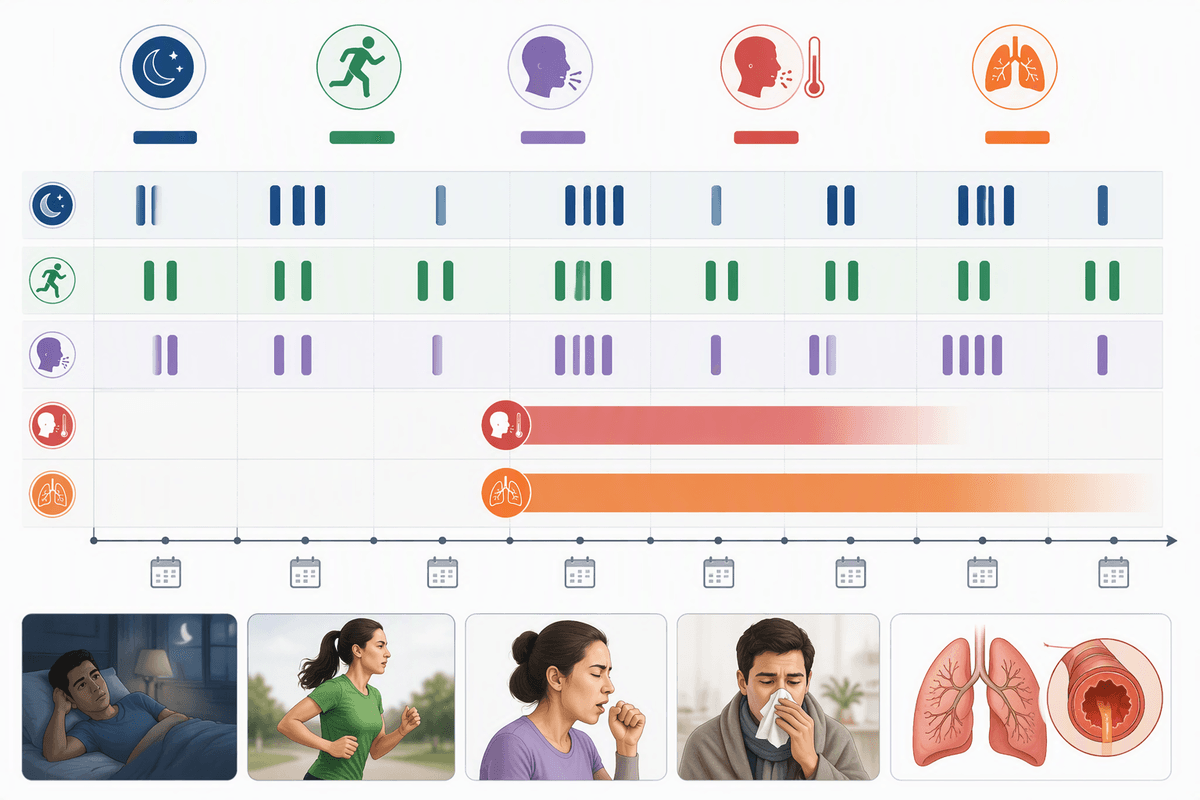
Sometimes the clue isn’t a dramatic episode—it’s the way your child’s breathing changes in the background. A cough that only shows up after tag, the “little wheeze” you hear on certain nights, or the way they ask to be carried on hills can seem unrelated when each moment is brief. In some families, the pattern hides inside routines: extra water by the bed, more pillows, more “breaks” at practice, fewer sleepovers because mornings feel rough. None of it screams emergency, so it’s easy to file away as quirks, fitness, or another lingering virus.
Over time, those small moments often cluster around the same triggers—colds that move into the chest, seasonal shifts, dusty basements, wildfire-smoke days, or the first weeks back at school. A mobile screener can help by turning “it comes and goes” into a timeline: how often nights are interrupted, how consistently exercise leads to coughing, and whether recovery keeps stretching past what feels typical. Even then, the picture can be uneven, which is part of why it’s so hard to trust memory alone.
Screening results versus clinical diagnosis and next steps
The tricky moment often comes when the app returns something that sounds definitive—“higher risk,” “possible asthma,” or a score that jumps after a rough week—while your child looks fine that afternoon. A screening result is more like a well-organized suspicion than a label. It reflects the pattern you entered (nights, exercise cough, colds that linger), not a direct measurement of what your child’s airways are doing in the clinic.
That difference matters at the next visit. A clinician still has to sort out whether the symptoms fit a treatable breathing pattern or whether something else explains them, and the answer isn’t always clean on one appointment day. The practical value of the screener is that it brings dates and situations—soccer, bedtime, the third “chest cold” this season—so the conversation can move from “sometimes” to “here’s when.” From there, next steps may look like breathing tests when age-appropriate, a focused exam, or a referral if the pattern keeps repeating.
A simple prompt that can create unexpected uncertainty
The question that tends to wobble people isn’t the big one—it’s the small prompt that follows: “In the past 4 weeks, how many nights did this wake them up?” Suddenly you’re replaying bedtimes you barely remember. Was that cough a one-off cold night, or the third time this month? Did they wake because they were scared, because the room was dry, or because their chest felt tight? When symptoms come and go, the mind rounds everything down to “not that often,” especially if the last few days were quiet.
A mobile screener can make that uncertainty feel louder at first, because it asks you to pick a number anyway. But that discomfort is sometimes the point: it exposes where your story has gaps. Seeing “I’m not sure” next to exercise cough or night wakings can be the nudge that turns vague worry into a trackable pattern—without pretending the pattern is perfectly consistent.
Trade-offs for families and clinicians using mobile screening

The push notification tends to land at the worst time—right as you’re packing lunches or trying to get a kid out the door. And when the question is the same one again (“any cough with play?”), it can feel like you’re either overthinking every throat-clear or missing the moment that actually matters. For some families, the steady logging becomes reassuring; for others, it adds a low hum of vigilance that doesn’t match how “fine” the day looks.
A timeline can be clearer than memory, but it can also surface messy, mixed weeks: a spike during a cold, quiet stretches, a few bad nights that don’t repeat. More data doesn’t always mean a simpler answer; it can mean more sorting. Still, the screeners that work best don’t just count symptoms—they show context (exercise, bedtime, seasonal shifts), which can make a follow-up conversation feel less like guesswork and more like comparing patterns.
When screening improves connection to respiratory care
The helpful shift often happens on an ordinary day: you open the app to log “no symptoms,” and realize that the last tough night was three weeks ago—right after the same kind of cold that always seems to move into the chest. Or you notice the opposite: every Tuesday practice ends with the same cough, even when everything else is fine. That kind of repeatable detail can be hard to carry into a clinic visit from memory, especially when your child is sitting there breathing normally.
When a screener turns those moments into dates, it can make the next step feel less like a leap. Instead of “they get sick a lot,” you can point to night wakings during colds, exercise-related coughing, and how long symptoms linger. It still won’t guarantee a clear answer—some weeks stay confusing—but it can help a pediatrician decide whether it’s time for breathing tests, a more focused plan, or a referral, without waiting for a dramatic flare to “prove” the pattern.