Start with fixed dates, then define trip priorities
The first time I planned Portugal with flights already locked, I made the classic mistake: I started pinning places on a map before I wrote down the two dates that actually mattered—arrival day and departure day. Once those are non-negotiable, everything else becomes a trade-off you can evaluate instead of a wish list you’ll feel guilty about.
Start by sketching your trip in whole days, not nights. A 7–12 day window sounds generous until you count the “half-days” lost to landing, checking in, and getting oriented—or the last-day squeeze of returning to the airport. Then pick your priorities in plain language: do you want big-city layers (Lisbon viewpoints, Porto cellars), or do you want slower coast time (Algarve beaches) even if it costs you a long transfer day? Trying to do Lisbon, Porto, and the Algarve works best when you’re willing to sacrifice depth somewhere—either fewer day trips, fewer neighborhoods, or fewer hotel changes.
If you’re torn, choose a “must feel” and a “nice to see.” For example: must feel = two unrushed city days in Lisbon; nice to see = one coastal reset day. That one sentence will save you from overbooking trains, chasing sunset spots every night, and realizing—too late—that your itinerary is technically possible but emotionally exhausting.
Choose base regions that fit your time window
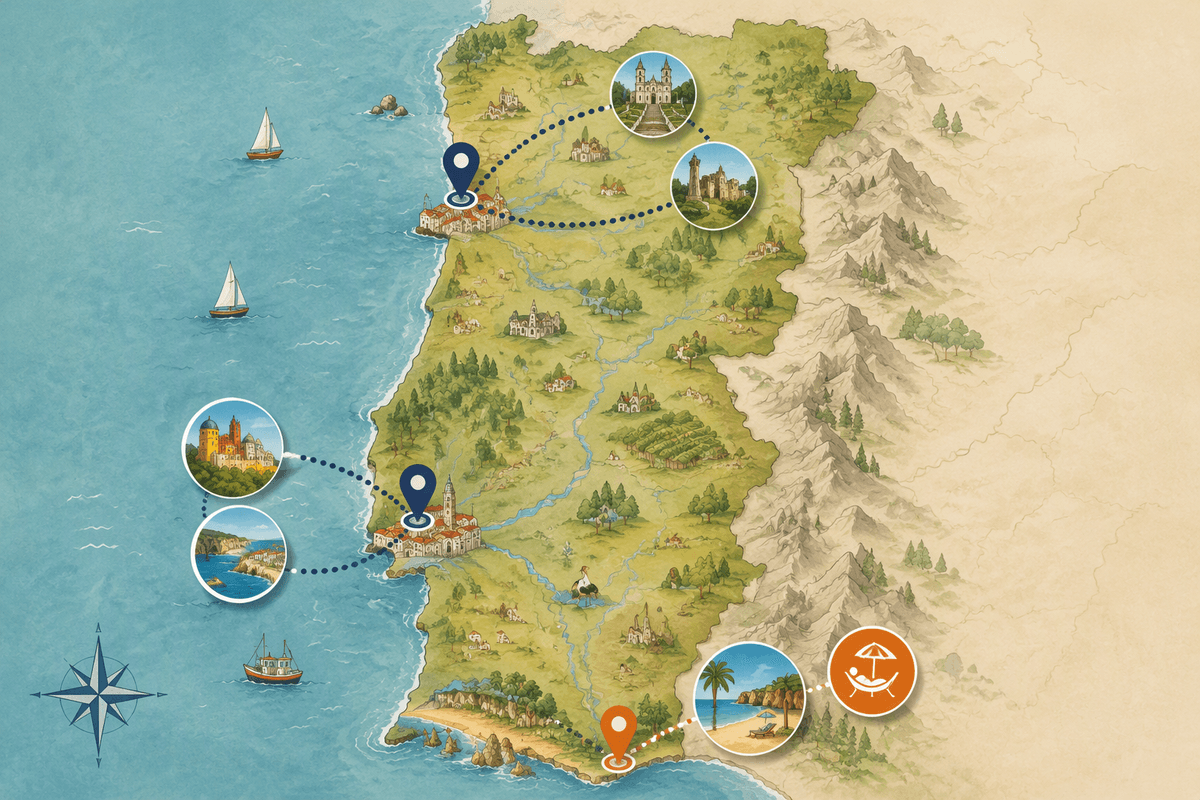
The first real decision usually hits when you realize you can’t “just add” the Algarve without paying for it somewhere—often in the form of a chunky travel day and one more hotel check-in when you’re already tired.
With 7–8 days total, two bases is the sweet spot: Lisbon + Porto, or Lisbon + Algarve (if you’re skipping Porto). At 9–10 days, Lisbon + Porto becomes comfortable and you can still earn a single coast reset day—either by day-tripping (Cascais/Sintra from Lisbon; Braga/Guimarães from Porto) or by adding the Algarve only if you’re willing to shorten one city. At 11–12 days, three regions can work, but only if you keep bases stable (2–3 nights minimum) and treat “between” days as low-output days—no late dinners, no museum marathons, and definitely no ambitious sunset chase after a long transfer.
Draft a flexible route: Lisbon–Porto–Algarve options
I usually draft the route in pencil first, because the temptation is to “connect the dots” and forget that every dot comes with a checkout time. Lisbon–Porto by train is the cleanest spine: it’s fast enough that you don’t lose the whole day, and frequent enough that you can choose a mid-morning departure instead of forcing yourself onto an early train after a late night.
If you’re deciding whether to add the Algarve, the real question is where you want your longest transfer to sit. Lisbon ⇄ Algarve is straightforward and can be a single base swap; Porto ⇄ Algarve is the one that quietly eats momentum (long ride, more moving parts, and you arrive tired). For 7–9 days, I like “Lisbon → Porto” and keep the coast as a day-trip release valve (Cascais if you want easy; Sintra if you’re okay trading crowds for payoff). For 10–12 days, “Lisbon → Algarve → Porto” can work if your departure flight is from Porto—otherwise you’re paying for the backtrack.
Keep hotel changes to a maximum of two, and watch the day-trip trap: Sintra, Douro, and “quick” beach days don’t feel quick when you stack them on top of transfers. The flexible move is leaving one unassigned day in each city—your buffer for rain, fatigue, or the one place you didn’t know you’d care about until you arrived.
Lock transport first: trains, flights, car, ferries
The moment my route stops being a “draft” is when I price and sanity-check the long jumps. Portugal looks small on a map, but your trip lives or dies on whether you’re moving smoothly between bases—or wrestling with a chain of connections while dragging a suitcase over cobblestones.
For Lisbon ↔ Porto, I lock the train first. It’s the one transfer that’s reliably efficient, and booking earlier usually gives you better fares and seats; the friction is that the cheapest options vanish faster than you expect, especially around weekends and holidays. If you’re adding the Algarve, decide whether you’re going rail-only (Lisbon ↔ Faro/Lagos is doable, but Lagos often means an extra leg) or whether a car is worth it for the “last-mile” beaches. A car buys freedom in the Algarve; it also buys you parking stress in Lisbon/Porto—so I treat it like a regional tool, not a trip-long identity.
Flights inside mainland Portugal rarely earn their complexity in a 7–12 day window, but I do check them if my departure airport isn’t Lisbon. Ferries are the same: great when they’re the point (a specific crossing), not as a patch for an overstuffed route. If a transport option needs three timed pieces to work, I assume one will slip—and plan accordingly.
Add buffers for weather, strikes, and slow travel days
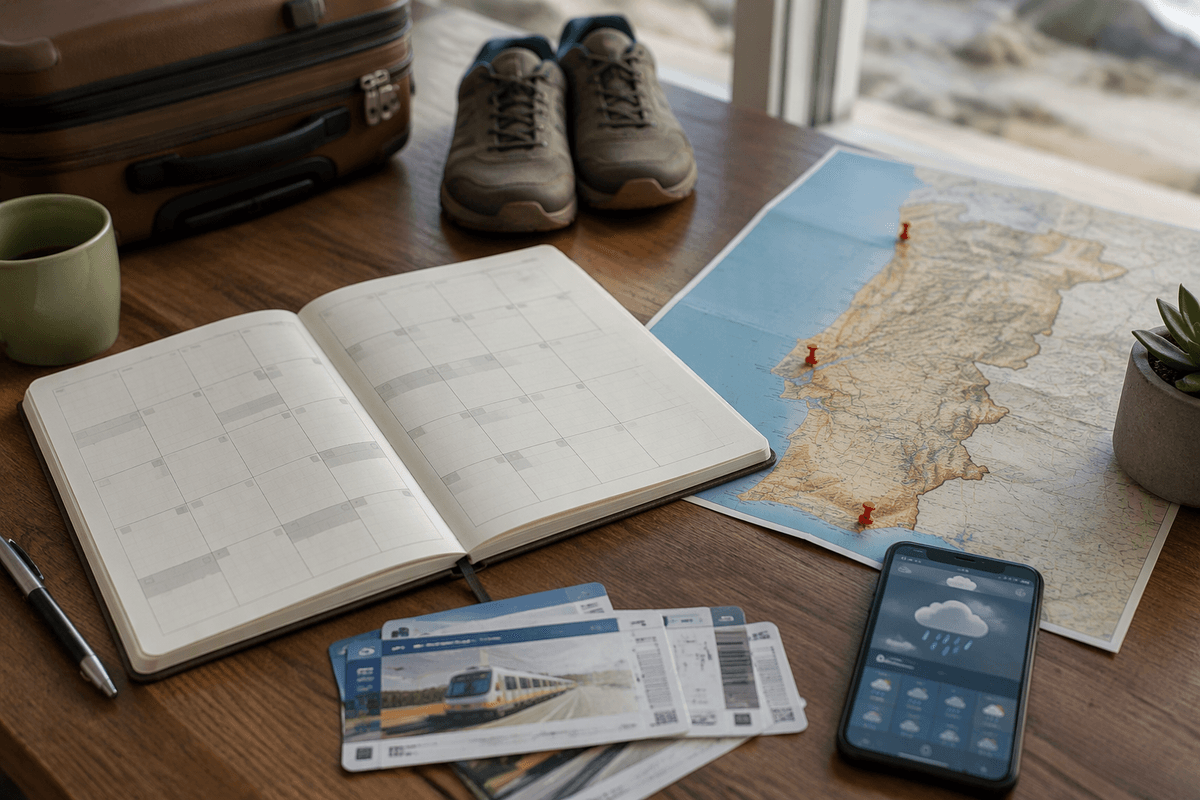
I always think I’m “being efficient” when I schedule a transfer day and a big-ticket sight on the same calendar square—until I hit the first real-life slowdown. In Portugal, the slowdown is often boring rather than dramatic: rain that makes viewpoints pointless, a delayed train that compresses your afternoon, or just the cumulative drag of stairs, cobblestones, and carrying a suitcase farther than the map implied.
The buffer that pays off fastest is a real, blank half-day in each base—especially Lisbon and Porto. Not a “maybe I’ll do Belém” half-day, but a no-reservations block that can absorb a wet morning, a late start, or a long lunch that turns into your best memory. If you’re trying to add the Algarve, treat the travel day as low-output on purpose: arrive, check in, take a short walk, and call it. Planning a sunset mission to Lagos or a big dinner reservation that night is how “doable” itineraries start feeling like work.
Strikes and service disruptions are rare until they aren’t, and they hurt most when you’ve chained timed pieces together. I build my Plan A around one clean, direct long transfer (Lisbon–Porto; Lisbon–Faro), and I keep Plan B simple: a later departure option, or a same-day bus fallback. If your departure flight is tight, the practical move is sleeping in the departure city the night before—even when it costs you one more hotel change.
Finalize bookings and a Plan B for departure day
The last time I “finished” a Portugal plan, the friction didn’t show up in the sightseeing—it showed up in the boring admin: a gorgeous hotel I couldn’t cancel, a train time that looked fine until I remembered check-out, and a departure morning where every extra connection felt like a gamble. This is the point where I stop optimizing for the perfect route and start optimizing for a calm final 24 hours.
I finalize bookings in this order: the last night first (closest to the airport you’re flying out of), then the long transfers, then the first two nights. You’ll lose some spontaneity—but you gain a trip that doesn’t collapse if you’re tired or it rains. If you’re torn between “one more night in Porto” and “sleeping near Lisbon for an early flight,” choose the sleep-near-the-airport option; it’s not romantic, but it protects your trip from a single delayed train or a slow taxi morning.
For Plan B, I write down one same-day fallback for each big move: a later train, a bus option, and the simplest taxi/Uber scenario—plus the address of your final hotel and the airport terminal. It’s five minutes of work that pays for itself the moment something slips.