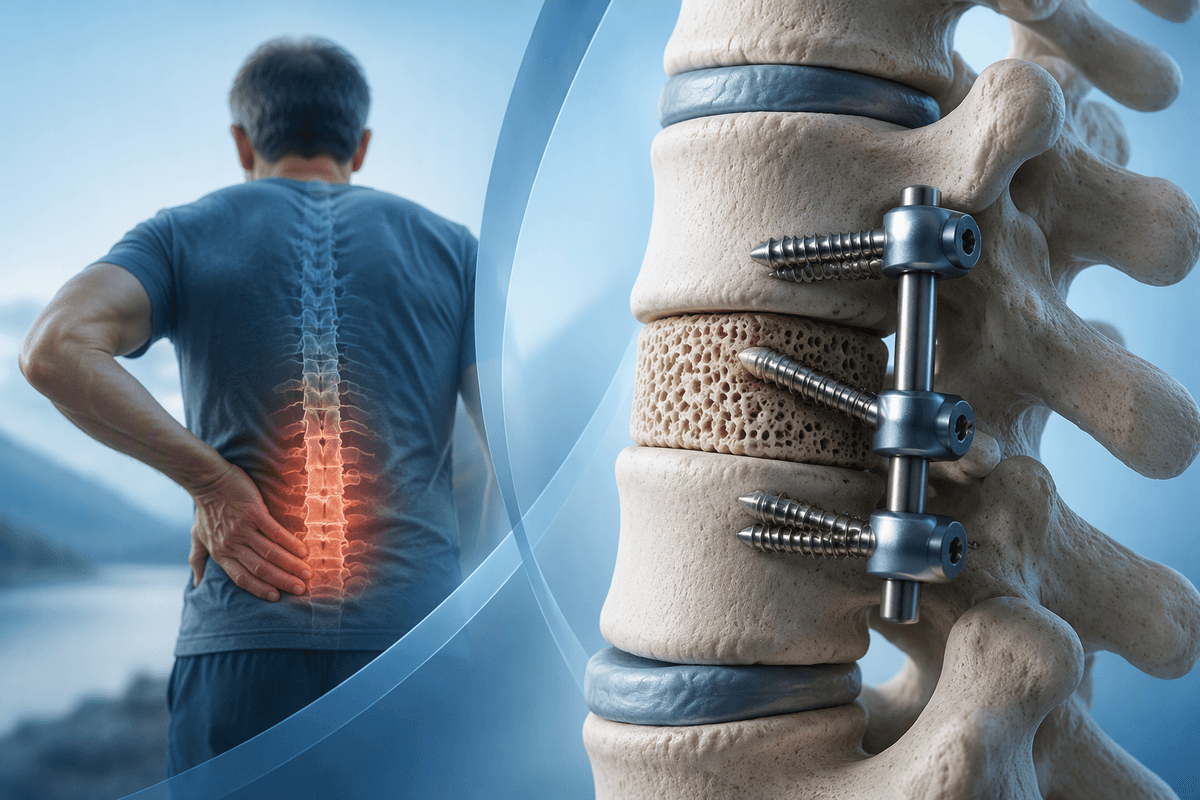
Why “fusing” a spine can seem appealing
It’s often a small, repeatable motion that convinces people something in their spine is “loose”—the sharp pinch when you roll over, the jolt when you step off a curb, the way sitting up from the couch feels like a hinge catching. After weeks or months of guarding, that idea of simply stopping the movement can sound less like an aggressive surgery and more like a practical fix: make the sore segment stop moving, and the irritation stops getting re‑triggered.
That appeal is real, but it can also blur what fusion actually does. Fusion isn’t a reset button so much as a trade: one level becomes more stable, while nearby joints, discs, and muscles may take on different loads to keep you bending, turning, and absorbing impact. Even early on, day-to-day changes can be inconsistent—some movements feel safer quickly, while others flare because your body is still relearning how to move around a newly “quiet” segment.
Where the novel procedure aims to change outcomes

The first time you move “normally” after a new technique is discussed, the question usually isn’t philosophical—it’s practical: will I be able to get out of bed without that hinge-like catch, and will that improvement stick past the first few weeks? Novel fusion approaches tend to aim at that gap between early stability and long-term function. Instead of only trying to lock a segment down, they’re often designed to control how it’s stabilized—reducing micro-motion that can keep tissues irritated, while trying to avoid an overly rigid construct that makes the rest of the spine feel like it has to compensate immediately.
In real-life terms, the promise is less “more fusion” and more “cleaner mechanics during healing.” If the painful level stops slipping or twisting in a way your muscles can’t reliably guard against, you may see fewer surprise jolts and a steadier return to sitting, walking, or reaching. But those changes can still come in uneven waves, because your nervous system, habits, and stamina may lag behind the hardware—even when the segment itself is quieter.
The hidden tradeoff: stability can shift stress elsewhere
You notice it in the ordinary tasks first: loading the dishwasher, twisting to grab a bag from the passenger seat, stepping down off a porch. The “caught hinge” feeling at the painful level may calm down, but a different area starts speaking up—an ache higher up between the shoulder blades, a nagging low-back tightness on longer walks, or a new soreness that wasn’t the main problem before. It can feel unfair, like the surgery “moved” the pain, even when the original motion-trigger is genuinely quieter.
That’s the tradeoff hidden inside stability. When one segment stops contributing its share of bending and shock absorption, nearby levels often take a little more rotation, flexion, and load to keep your overall movement the same. In some situations, that extra demand shows up as flare patterns: you tolerate short, careful movements but pay for longer sessions, or you feel fine until you add speed, carrying, or uneven ground. These shifts don’t automatically mean something is wrong, but they can complicate what “better” looks like day to day.
Bone healing is a process, not an instant result
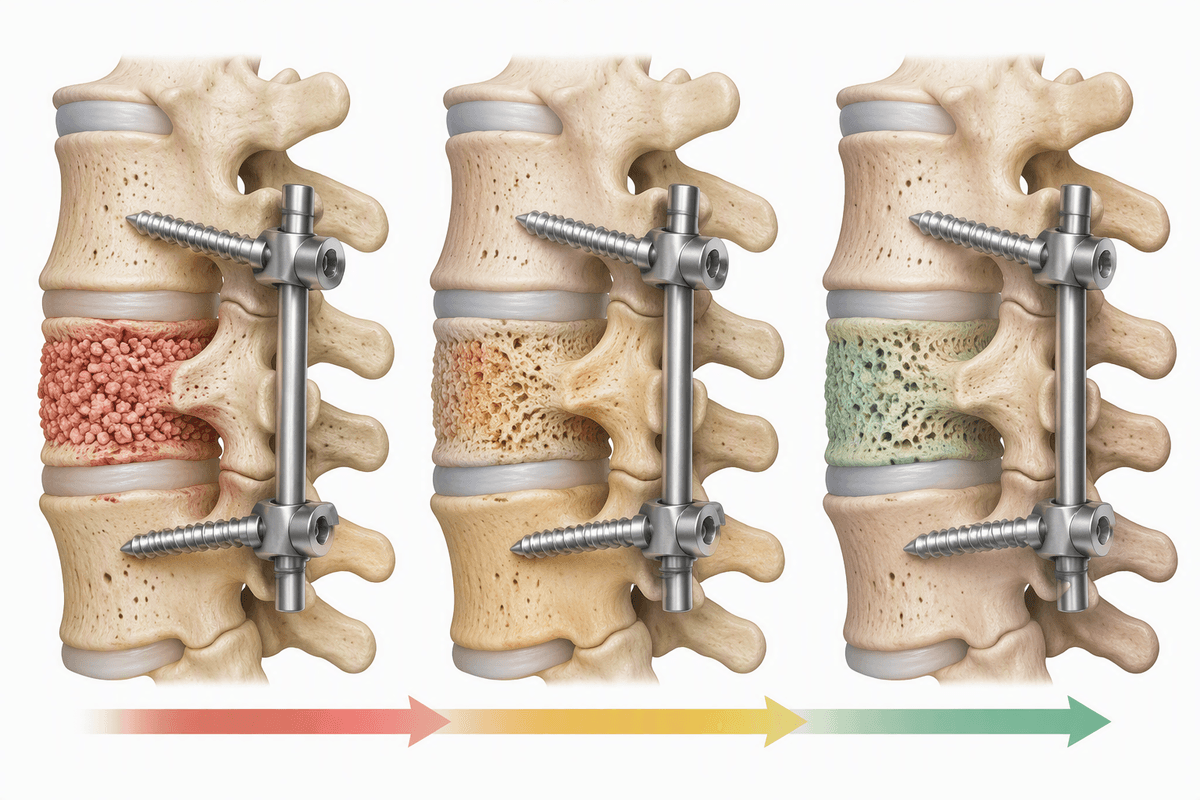
The first time you sit up and feel the “hinge” calm down, it’s easy to assume the job is done—and then get rattled when week three or week six feels strangely fragile again. Part of that whiplash is that the hardware can make a segment feel steady before your body has truly converted that plan into living bone. Early on, the construct is doing a lot of the work; the biology is still catching up. So a good day can follow a bad one without either proving success or failure.
Bone healing tends to move in stages, and it doesn’t always match your calendar or your motivation. Small increases in walking, sitting time, or lifting can expose the difference between “protected stability” and “solid fusion,” especially when fatigue changes your posture and you start moving like your old self. In that in-between period, soreness may drift—less sharp motion-pain at the target level, but more stiffness, deep aching, or muscle guarding nearby—because your spine is still negotiating how to share load while the fusion matures.
When “doing more” surgically creates new confusion
It can be unsettling when the plan gets described as “a little more”—another level included, a larger implant, extra screws, a different approach—because it sounds like safety, yet it also changes what you’re supposed to feel afterward. The original trigger may quiet down, but the signal from your body can get noisier: new nerve-y zings that come and go, a deep ache that feels hard to place, or a stiffness that’s stronger than the pain you went in for. In that moment, “more stable” doesn’t always translate into “more clear.”
Part of the confusion is that bigger constructs can solve one mechanical problem while creating a new baseline for movement. If you’ve limited motion across more tissue, your muscles may work differently, and adjacent areas may flare for reasons that aren’t obvious in the mirror. Even your progress markers can get fuzzy—walking improves while sitting worsens, or the painful jolt disappears but endurance lags—because multiple systems are adapting at once, not in sync.
Who might benefit, and who faces harder tradeoffs
It’s often a small detail that changes the math—like realizing your worst pain isn’t from “wear and tear” in general, but from a very specific motion you can reproduce: a slip, a twist, a jolt that your muscles never quite learn to guard against. People who fit that pattern sometimes do better with a fusion conceptually, because the goal is straightforward: remove an unreliable movement so daily tasks stop springing surprises. When imaging and symptoms line up tightly at one level, the promise of steadier mechanics during healing can be more realistic.
The tradeoffs feel heavier when the picture is messier: pain that migrates, multiple worn levels, major deconditioning, or a nervous system that’s been on high alert for months. In those situations, even a “better” construct may leave you with new stiffness, odd flare rhythms, or a slower return of confidence because nearby segments and soft tissues still have to carry the work. The improvement may show up as fewer sharp triggers, not an immediate, clean sense of being normal again.
What researchers measure to judge if it truly helps
At a follow-up visit, it can be tempting to treat one image as the verdict: either it “fused” or it didn’t. Researchers usually have to be fussier than that, because day-to-day life rarely changes in just one direction. They track pain scores, but also when pain shows up—first steps in the morning versus the last hour of a workday—and whether flare patterns shrink or simply relocate.
They also look at function in ways that don’t always feel dramatic: walking tolerance, sit-to-stand ease, time off pain medications, and whether people regain confidence with bending, carrying, or driving. Imaging matters, but it’s typically paired with signs of stability over time and with complication rates—reoperations, hardware problems, or new symptoms at nearby levels. A “successful” fusion on scans can still coexist with guarded movement, while a slower-looking fusion can sometimes match steady, usable improvement.